Art Quiz Some of the Features of Romanticism Included
10 Cardinal Characteristics of Romanticism in Literature
Understanding the characteristics of Romanticism in literature can aid y'all become a better reader, and it can give y'all a leg up on literary essays and discussions. This menstruum in literary history is fascinating and dramatic, and once you lot know the telltale signs, you'll be able to identify work that typifies it.
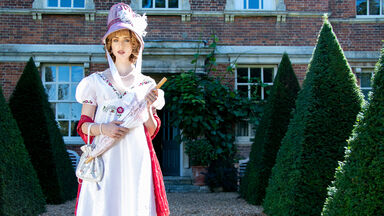 characteristics of romanticism represented by woman'south wearing apparel
What Is Romanticism in Literature?
Popular in the belatedly 18th and early on 19th centuries, Romanticism was a literary movement that emphasized nature and the importance of emotion and artistic freedom. In many ways, writers of this era were rebelling against the attempt to explain the earth and homo nature through scientific discipline and the lens of the Industrial Revolution. In Romanticism, emotion is much more than powerful than rational thought.
What Are the Characteristics of Romanticism in Literature?
Although literary Romanticism occurred from about 1790 through 1850, not all writers of this period worked in this style. There are sure characteristics that make a piece of literature part of the Romantic motion. Y'all won't find every characteristic nowadays in every piece of Romantic literature; however, you will commonly find that writing from this catamenia has several of the key characteristics.
1. Glorification of Nature
Nature, in all its unbound celebrity, plays a huge role in Romantic literature. Nature, sometimes seen as the opposite of the rational, is a powerful symbol in work from this era. Romantic poets and writers give personal, deep descriptions of nature and its wild and powerful qualities.
Natural elements likewise work as symbols for the unfettered emotions of the poet or author, as in the final stanza of "To Autumn" past John Keats. Keats was aware that he was dying of consumption throughout much of his brusk life and career, and his celebration of autumn symbolizes the beauty in the imperceptible.
Where are the songs of spring? Ay, Where are they?
Think not of them, thousand hast thy music also,—
While barred clouds bloom the soft-dying twenty-four hours,
And touch on the stubble-plains with rosy hue;
Then in a wailful choir the small-scale gnats mourn
Among the river sallows, borne aloft
Or sinking as the lite current of air lives or dies;
And full-grown lambs loud bleat from hilly bourn;
Hedge-crickets sing; and now with treble soft
The red-chest whistles from a garden-croft;
And gathering swallows twitter in the skies.
two. Awareness and Acceptance of Emotions
A focus on emotion is a primal feature of most all writing from the Romantic period. When y'all read work of this menstruation, you'll see feelings described in all forms, including romantic and filial beloved, fear, sorrow, loneliness, and more. This focus on emotion offered a counterpoint to the rational, and it as well made Romantic poetry and prose extremely readable and relatable.
Mary Shelley'due south Frankenstein offers a perfect case of this characteristic of Romanticism. Hither, Frankenstein's monster shows great self-awareness of his feelings and offers a vivid emotional description total of anger and sadness.
I continued for the residuum of the solar day in my hovel in a state of utter and stupid despair. My protectors had departed and had cleaved the only link that held me to the world. For the offset time the feelings of revenge and hatred filled my bosom, and I did not strive to command them, but allowing myself to be borne away by the stream, I aptitude my heed towards injury and death. When I thought of my friends, of the mild phonation of De Lacey, the gentle optics of Agatha, and the exquisite dazzler of the Arabian, these thoughts vanished and a gush of tears somewhat soothed me. But again when I reflected that they had spurned and deserted me, anger returned, a rage of anger, and unable to injure anything human, I turned my fury towards inanimate objects. As nighttime advanced I placed a variety of combustibles around the cottage, and after having destroyed every vestige of cultivation in the garden, I waited with forced impatience until the moon had sunk to commence my operations.
three. Celebration of Creative Inventiveness and Imagination
In contrast to the previous generations' focus on reason, writers of the Romantic movement explored the importance of imagination and the artistic impulse. Romantic poets and prose writers historic the power of imagination and the creative process, as well as the artistic viewpoint. They believed that artists and writers looked at the world differently, and they celebrated that vision in their piece of work.
You can see this in William Wordsworth's verse form, "The Prelude."
Imagination—here the Ability so called
Through sad incompetence of human oral communication,
That atrocious Power rose from the mind's completeness
Like an unfathered vapour that enwraps,
At once, some lone traveller. I was lost;
Halted without an attempt to interruption through;
But to my conscious soul I now can say—
"I recognise thy glory:" in such strength
Of usurpation, when the light of sense
Goes out, merely with a flash that has revealed
The invisible world….
4. Emphasis on Aesthetic Beauty
Romantic literature likewise explores the theme of aesthetic dazzler, not just of nature merely of people as well. This was especially true with descriptions of female beauty. Writers praised women of the Romantic era for their natural loveliness, rather than anything artificial or constrained.
A classic case of this characteristic is George Gordon, or Lord Byron's, verse form "She Walks in Beauty."
She walks in beauty, like the night
Of cloudless climes and starry skies;
And all that's best of nighttime and bright
See in her aspect and her optics;
Thus mellowed to that tender light
Which heaven to gaudy twenty-four hours denies.
5. Themes of Solitude
Writers of the Romantic era believed that creative inspiration came from alone exploration. They celebrated the feeling of beingness lone, whether that meant loneliness or a much-needed placidity space to recollect and create.
You'll encounter solitary themes in many literary works from this period, including in this excerpt from Samuel Taylor Coleridge'south poem "Frost at Midnight."
The Frost performs its undercover ministry,
Unhelped by any wind. The owlet'due south weep
Came loud—and hark, over again! loud equally before.
The inmates of my cottage, all at residue,
Take left me to that solitude, which suits
Abstruser musings: save that at my side
My cradled infant slumbers peacefully …
six. Focus on Exoticism and History
Romantic-era literature often has a singled-out focus on exotic locations and events or items from history. Poems and prose touch on antiques and the gifts of aboriginal cultures around the world, and far-away locations provide the setting for some literary works of this era.
I great example is Percy Byssche Shelley's verse form "Ozymandias."
I met a traveler from an antique country,
Who said—"Two vast and trunkless legs of stone
Stand up in the desert. . . . Nearly them, on the sand,
Half sunk a shattered visage lies, whose frown,
And wrinkled lip, and sneer of cold command,
Tell that its sculptor well those passions read
7. Spiritual and Supernatural Elements
The writers of the Romantic era did non plow away from the darker side of emotion and the mysteries of the supernatural. They explored the contrast betwixt life and death. Many pieces have Gothic motifs, such every bit estate houses in disrepair, dark and stormy nights, and more.
Some of the supernatural elements serve as symbols for emotions of guilt, depression, and other darker feelings, as you tin can see in this extract from The Fall of the House of Usher by Edgar Allan Poe.
I learned, moreover, at intervals, and through broken and equivocal hints, another singular feature of his mental status. He was enchained past sure superstitious impressions in regard to the dwelling which he tenanted, and whence, for many years, he had never ventured forth --in regard to an influence whose supposititious force was conveyed in terms besides shadowy here to exist re-stated --an influence which some peculiarities in the mere form and substance of his family mansion, had, by dint of long sufferance, he said, obtained over his spirit-an effect which the physique of the grayness walls and turrets, and of the dim tarn into which they all looked downward, had, at length, brought about upon the morale of his existence.
viii. Bright Sensory Descriptions
Another essential feature of nearly all Romantic-era literature is vivid sensory descriptions. The poems and prose of this menstruum include examples of simile and metaphor, equally well equally visual imagery and other sensory details. Poets and other writers went beyond simply telling near things and instead gave the information readers need to feel and sense of taste and touch the objects and surround in Romantic-era writing.
Wordsworth uses brilliant descriptions, including similes and metaphors, in his famous poem, "I Wandered Lonely as a Cloud."
I wandered lonely as a cloud
That floats on high o'er vales and hills,
When all at once I saw a crowd,
A host, of golden daffodils;
Beside the lake, beneath the trees,
Fluttering and dancing in the cakewalk …
9. Utilize of Personification
Romantic poets and prose writers also used personification in their piece of work. You tin encounter examples of personification of everything from birds and animals to natural events or aspects. These works even personify feelings similar love or states similar death.
You can see Romantic personification in the work of the famous naturalist and writer, Karl von Martius. Here is an excerpt most the copse of the Amazon from his book Flora Brasiliensis.
I am impelled by some inner urge to tell you, gentle reader, these thoughts of my mind, since I am presenting to your optics a picture of those about ancient trees which I once saw abreast the Amazon River. Even today, after many years have gone by, I feel myself struck by the appearance of those giants of great age, in the same style every bit by the face of some giant human. Even today those trees speak to me and make full my spirit with a certain pious fright, even today they excite in my breast that silent wonder with which my spirit was held at that time. This wonder is similar a wide and deep river; the thoughts of the human mind are its waves; not all feelings of the middle are to be expressed with words....
10. Focus on the Self and Autobiography
Many works of Romantic-era literature are deeply personal, and they often explore the self of the writer. Yous'll encounter autobiographical influences in poems and prose of the menstruation. One feature of this movement was the importance placed on feelings and creativity, and the source of much of this emotional and artistic work was the background and real-life surroundings of the writer. This self-focus preceded confessional poetry of the mid-1900s, but you tin can see its profound influence on that movement.
One key example of Romantic autobiography is Jean-Jacques Rousseau's Confessions. In this piece of work, he endeavored to create an unvarnished look at his own upbringing and life.
I have begun on a work which is without precedent, whose accomplishment will have no imitator. I suggest to set before my fellow-mortals a man in all the truth of nature; and this human shall be myself.
I have studied flesh and know my eye; I am not made like any ane I have been acquainted with, perhaps like no i in existence; if not ameliorate, I at to the lowest degree claim originality, and whether Nature has acted rightly or wrongly in destroying the mold in which she bandage me, can merely be decided after I have been read.
Key Poetic Forms of Romanticism
If yous are studying poetry of the Romantic era, it's helpful to know the forms that were pop during this fourth dimension. These included odes, sonnets and lyrics. Take a look at examples of odes by Romantic poets like Keats, every bit well as sonnet examples by the likes of Percy Shelley. Understanding these poetic forms and their human relationship to Romanticism volition requite you a deeper appreciation of this work.
Source: https://examples.yourdictionary.com/10-key-characteristics-of-romanticism-in-literature.html
0 Response to "Art Quiz Some of the Features of Romanticism Included"
Post a Comment